
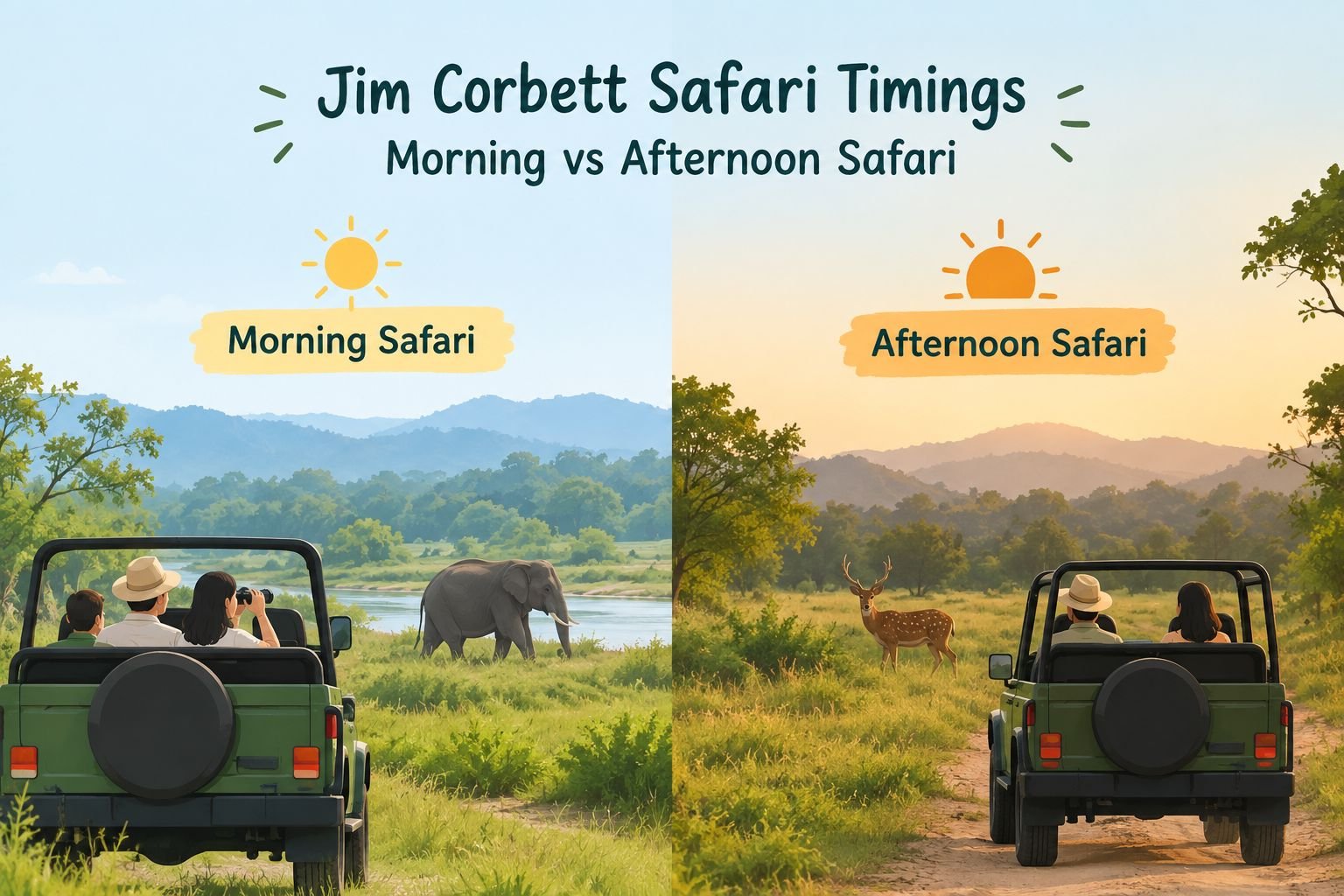
Jim Corbett Safari Timings: Morning vs Afternoon Safari
Written: Sep 08, 2026 | Updated: Sep 08, 2026
Jim Corbett runs its day safaris in two fixed shifts - a morning session and an afternoon session - and the exact Jim Corbett safari timings for both change with the season. Entry times shift by roughly an hour between winter and summer, and different entry gates follow slightly different closing times. So if you're trying to work out what time your safari actually starts and finishes, the short answer is: it depends on when you're visiting and which zone you've booked. This article breaks down both sessions, compares the morning and afternoon experience, and explains how the schedule changes through the year, using the current schedule published by Corbett Tiger Reserve.
Jim Corbett Safari Timings at a Glance
Corbett Tiger Reserve officially confirms that day safaris operate in two shifts - one in the morning and one in the afternoon - with a mid-day break in between.
| Season | Morning Session Entry |
|---|---|
| 15 November – 15 February (winter) | 6:45 AM |
| 16 February – 31 March | 6:15 AM |
| 1 April – 15 May | 5:45 AM |
Two things worth noting straight away. First, these are entry times, not the full shift - a safari typically runs for around three to four hours, so a morning safari entered at 6:00 AM will usually exit by mid-morning, and an afternoon safari entered at 2:00 PM will return around gate-closing time, which also varies by gate. Second, closing times differ by entry gate: for example, in the 16 February – 31 March block, the last entry at the Dhangarhi (Dhikala side) gate is 4:30 PM, at Amdanda (Bijrani side) it's 5:30 PM, and at Durgadevi it's 5:00 PM.
There's no single "official time" that applies to every zone and every month of the year - and any article or booking page that quotes one fixed timing for all of Corbett should be read with caution. Always verify the schedule against your booking date.
Morning Safari Timings in Jim Corbett
The morning shift is the earlier of the two sessions, and its start time tracks the seasons closely. During the winter months (15 November to 15 February), morning entry opens at 6:45 AM. As days lengthen, the entry gets earlier - 6:15 AM from mid-February, 5:45 AM from 1 April, and 5:30 AM in the hottest weeks from mid-May to mid-June.
What does this mean practically? In peak summer, you should expect to wake up well before 5:00 AM. Your resort will typically be a 20–45 minute drive from your entry gate (depending on which zone and gate your permit is for), you need time to collect your registered guide at the gate, and forest rules require all visitors to complete entry formalities within the prescribed window. In practice, most visitors aim to be dressed, fed (or carrying something light), and checked out of their room well over an hour before their slot opens.
The experience of a morning safari is shaped by its schedule. You enter as the forest is waking up - cool air, low light that slowly builds into bright morning sun, and quiet tracks before vehicle movement accumulates. The flip side is that mornings demand discipline: a late night, a missed alarm, or a slow breakfast can cost you the slot entirely, because the shift doesn't wait.
Afternoon Safari Timings in Jim Corbett
The afternoon session begins after the mid-day break, and its entry time also shifts with the seasons. In winter, afternoon entry is at 1:00 PM - the earliest of the year, since daylight fades fastest. From mid-February it moves to 2:00 PM, and in the long summer days of April and May it runs as late as 3:00 and 3:15 PM respectively.
The afternoon session generally runs until gate closing time, which depends on your entry gate. Using the 1 April – 15 May block as an example, last entry times are 5:30 PM at Dhangarhi, 6:30 PM at Amdanda, and 6:00 PM at Durgadevi - so the end of your safari can differ by a full hour depending on which gate your permit.
The afternoon experience is different in feel. Early afternoons in summer can be hot and quiet - much of the wildlife rests through the peak heat - but the session benefits from the second half: as the sun drops, air cools, light softens, and animal movement picks up again. Afternoon safaris are also far easier to plan around. There's no pre-dawn start, you can travel to Corbett the same morning in some cases, and you finish in time for dinner rather than a nap.
One more scheduling point: Dhikala - the reserve's most sought-after zone for day visits - operates through a limited conducted-tour facility with only a small number of vehicles per shift, so its slots are both scarce and strictly bound to the official timetable
Morning vs Afternoon Safari: What Is the Difference?
Here's how the two sessions compare on the factors that actually matter for planning:
| Factor | Morning Safari | Afternoon Safari |
|---|---|---|
| Entry time | ~5:30–6:45 AM depending on season | ~1:00–3:15 PM depending on season |
| Wake-up demand | Very early; often before 5 AM in summer | Relaxed; normal morning available |
| Daylight | Low light at start, brightening through the shift | Bright at start, fading to golden evening light |
| Temperature | Coolest part of the day - carry layers in winter | Warmest at start in summer, cooling later |
| Forest atmosphere | Fresh tracks, quiet roads, active early hours | Quieter in peak heat, more movement toward evening |
| Session end | Usually mid-to-late morning | Around gate-closing time, which varies by gate |
| Planning flexibility | Harder - everything must align the night before | Easier - fits around same-day travel and late check-ins |
A few of these deserve unpacking. Daylight is a genuine difference: a morning shift begins in near-darkness for part of the year, which affects photography, while an afternoon shift ends in the best golden-hour light of the day. Comfort is the other practical contrast - winter mornings at Corbett are genuinely cold in an open jeep, while summer afternoons start hot. Neither is "better"; they simply suit different tolerances.
On wildlife sightings, the honest position is this: animals move most in the cooler, low-light hours of early morning and late afternoon, which is why forest departments schedule safaris in these windows in the first place. What no one can honestly promise is that a morning shift will show you a tiger and an afternoon one won't, or vice versa. Sightings depend on the day, the zone, the season, and a healthy amount of luck. Any claim that one session "guarantees" better sightings is not supported by how the reserve operates.
Which Safari Timing Should You Choose?
There's no universal answer - it comes down to your priorities and your schedule.
Choose the morning safari if you're comfortable with an early start and want the forest at its quietest, with cool temperatures and the day's first light. It suits travellers who treat the safari as the main event of their trip and don't mind reorganising sleep around it.
Choose the afternoon safari if you value sleep, are travelling with children or older family members, arrive in Corbett by late morning, or simply prefer a warmer, more relaxed start. In summer especially, the second half of an afternoon shift - as temperatures fall - is an equally active window.
If your trip allows only one safari and you can't decide, consider the season: in the peak heat of April–May, the early morning and late afternoon ends of the day are when the forest is most comfortable and most active, and both sessions capture one of those windows. If you can manage two safaris - one of each - you experience the forest at both ends of the day, which is the most complete option of all.
Do Jim Corbett Safari Timings Change With Season or Zone?
Yes, on both counts - this is the single most important thing to understand about Corbett safari timings.
By season: the reserve publishes four distinct seasonal blocks (mid-Nov to mid-Feb, mid-Feb to Mar, Apr to mid-May, mid-May to mid-Jun), and entry times move by up to 75 minutes between the winter and summer schedules. Morning entries get earlier as summer approaches; afternoon entries get later, tracking the lengthening daylight.
By zone and gate: while the seasonal blocks set the framework, last-entry and exit times differ by gate - the official schedule lists separate closing times for the Dhangarhi, Amdanda, and Durgadevi gates in every season. Zones also differ in access: Dhikala day visits run through a limited conducted-tour facility rather than standard day-safari permits, and some zones close entirely during the monsoon period before reopening on announced dates.
The practical takeaway: never assume the timing you read on a blog or heard from a friend applies to your booking. Check the schedule for your specific season and zone on the official Corbett Tiger Reserve portal before you finalise travel plans.
What Time Should You Be Ready for Your Safari?
Think of the published entry time as the deadline, not the start of your morning.
For a morning safari, work backwards from your gate. If your slot opens around 6:00 AM, and your resort is 30–40 minutes from the gate, you should be up by roughly 4:30–4:45 AM in summer (earlier allowances are wise for the first trips of the season, when gate positions and drive times are unfamiliar). Add a buffer for collecting your guide and completing entry formalities.
For an afternoon safari, the buffer matters less on the front end but the exit is fixed: the forest closes at the prescribed time, and safaris must exit within the shift. Plan your day so you reach the gate comfortably before your entry window, and don't schedule anything tight immediately after the safari returns - the drive back from remote zones can itself take a while.
A few timing-specific habits help regardless of session: confirm your gate and reporting time the evening before, keep your ID and permit details handy, and remember that permits are shift-specific - arriving late doesn't carry your slot into the next shift.
Frequently Asked Questions About Jim Corbett Safari Timings
Q. What are the morning safari timings in Jim Corbett?
Morning entry times change by season: 6:45 AM from 15 Nov–15 Feb, 6:15 AM from 16 Feb–31 Mar, 5:45 AM from 1 Apr–15 May, and 5:30 AM from 16 May–15 Jun, per the official Corbett Tiger Reserve schedule.
Q. What are the afternoon safari timings in Jim Corbett?
Afternoon entry runs from 1:00 PM in winter to 3:15 PM in peak summer, depending on the seasonal block. Exit is around gate-closing time, which also varies by entry gate.
Q. Is Jim Corbett safari available in both morning and afternoon sessions?
Yes. The reserve officially operates day safaris in two shifts - morning and afternoon - with a mid-day break between them.
Q. Does Jim Corbett safari timing change by season?
Yes, significantly. Entry times shift across four published seasonal blocks, with up to 75 minutes' difference between winter and summer schedules.
Q. Does safari timing differ between zones?
The seasonal blocks apply across the reserve, but last-entry and closing times differ by gate (for example, Dhangarhi, Amdanda, and Durgadevi each have separate closing times), and Dhikala day visits run under a separate limited conducted-tour facility. Verify the exact times for your zone and date.
Q. Which is better, morning or afternoon safari?
Neither is universally better. Morning offers the coolest, quietest hours; afternoon offers easier logistics and active wildlife movement toward evening. Choose based on your schedule and comfort rather than sighting claims.
Q. How long does a Jim Corbett safari session last?
A day-safari shift typically lasts around three to four hours, bookended by the official entry and exit times for your gate and season.
Q. Can safari timings change due to forest department rules?
Yes. Timings, zone openings, and booking windows are controlled by the Corbett Tiger Reserve administration and can change - including monsoon closures and reopenings. Always confirm current timings on the official portal before your visit.
Let's talk about it
You may also like
-
![How to Reach Jim Corbett from Delhi]()
-
![things-to-do-in-mukteshwar]()
Things to Do in Mukteshwar: A Complete Travel Guide for Nature & Adventure Lovers
-
![places-to-visit-in-bhimtal]()
Places to Visit in Bhimtal: Complete Travel Guide for a Peaceful Uttarakhand Getaway


